-
“Nice And Blue (Pt. 2)”
This song is a follow-up to “Nice and Blue” from A To B Life. There are several direct references that song in the lyrics, which was about Amanda, a former love interest. Musically, the song starts with guitars and drums. Bass comes in with the vocals in the verse, which also features ethereal background “ahhhh” vocals. There is a prechorus before the first chorus that is played again directly after the chorus instead of in the lead up to the second chorus. There’s also a glorious lead guitar transition into each chorus. The second chorus is followed by a disjointed bridge and a softer chorus to end the song.
You were a song I couldn’t sing
Caught like a bear by the bees
With its hand in a hive
Who complains of the sting
When I’m lucky I got out alive!
A life at best left half-behind
The taste of the honey
Still sweet on my tongue
And I’d run (Lord knows I’ve tried)
But there’s no place on Earth
I can hide from the wrong I’ve done
“You were a song I couldn’t sing” is a direct reference to “Nice and Blue”. The line refers to his relationship with a former love interest, which he now sees as an unattainable goal. By the lyrics, it sounds like he views their relationship as having been based on desire, which he views as bad. He’s complaining about whatever painful consequences have resulted from the relationship, though they could have been much worse. He’s having trouble moving on (“A life at best left half-behind” is a reference to “A life left half behind” from “Nice and Blue”) from his actions, has tried to run from them to no avail.
——————-
Then I saw a mountain and I saw a city
(I was once the wine)
Steadily sinking but suspiciously calm
(I was once the wine)
It wasn’t an end, it wasn’t a beginning
(I was once the wine)
But a ceaseless stumbling on(And you were the wine glass)
There, strapped like a watch on my wrist
(I was once alive)
That’s finished with gold but can’t tell time
(I was once alive)
Was all or what little pleasure exists
(I was once alive)
Seductively sold and uselessly mine
(When you held me)The chorus is all about perspective. He has a negative view and sees only fleeting and cheap worldly pleasures. He looks out at the world, sees a mountain and a city sinking though nobody else seems to notice or care. He remarks on the hollow satisfaction in having a gold watch, but at the end of the day it’s useless because it can’t tell time.
——————-
Our horse was fast and first from the gate
With the lead of a length at the sound of the gun
And the last of our cash laid down to fate (at 17 to 1)
But by the final stretch in the rear of the pack
That nag limping bad in the back
We reluctantly gave all the money we’d saved
A fifth to the commonwealth and the rest to the track!Based on the rest of the song, I assume this verse is back to describing the relationship, which they bet everything they had on despite low odds of winning. They got along amazingly at first but toward the end it was clear they weren’t going to make it so they cut their losses, giving up one-fifth in taxes (to the Commonwealth of Pennsylvania) and the rest to the track.
——————-
Then I saw a forest grow in the city
(I was once the wine)
And a driftwood wall of birdhouse gourds
(I was once the wine)
And I’m still waiting to meet a girl like my mom
(I was once the wine)
(who’s closer to my age)
(I was once the wine)The true light of my eyes is a Pearl
(I was once alive)
Equally emptied to equally shine
(I was once alive)
And all or what little joy in the world
(I was once alive)
Seemed suddenly simple and endlessly mine
(When you held me)In contrast to the first chorus, he has fully given up the relationship. The city that had been steadily sinking grows a forest and a driftwood wall of birdhouse gourds. New possibilities out of nowhere.
Whereas the worldly pleasures of the first chorus were empty, now he’s talking about joy that is simple and endless, which brings to mind the “peace that passeth all understanding” St. Paul talks about in Philippians 4:7.
——————-
I was once the wine
I was once the wine
I was once the wine
And you were the wineglassI was once alive
I was once alive
I was once alive
When you held me
But God became the glass
All things left are emptiness
Oh, little girl…
You’re just a little girl
If you look out and see a trace
Of a dark bed was once my face
In the clarity of such grace
Forget all about meThe ending is similar to “Nice and Blue” except he doesn’t call her “my” little girl, and at the end he says “forget all about me” instead of “remember me”. He used to live his life for her, there was a time where he felt alive when she held him, but now he has turned to God instead.
-
“A Glass Can Only Spill What It Contains”
This song starts with the left guitar alternating between two notes. A second guitar (right ear) comes in playing a chord in individual ringing notes. Drums and bass come in with a two note pickup into the verse. There are a lot of little things to pay attention to in the verses. After “warm milk from my bowl”, the bass and right guitar duck out. They’re added back in after 2 and 4 lines respectively. The second verse features rim clicks on the words “clips” and “claws”. The last verse features changes in the drums and left guitar during “nobody knows me”. The transition into the first chorus is another great moment with the snare on “side” and “walls” coming on beat one of the chorus. The song ends with a guitar solo over the chorus.
——————-
A cat came drifting onto
My porch from the outside cold
And with eyes closed, drinking
Warm milk from my bowl
Thought: “Nobody hears me, nobody hears me
‘Cause I crept in so soft!
And nobody sees me, nobody sees me”
As I watched six steps offThis verse starts a recurring theme of the song, which is naiveté. In this verse, a cat drinks warm milk with eyes closed and without a worry in the world, unaware the narrator is watching it in close proximity. It seems like there’s an unwholesome connotation here, like he lured the cat there for some purpose.
——————-
Like the peacocks wandering
The walkways of the zoo
Who have twice the autonomy
The giraffes and tigers do
Saying:
“No one can stop me, no one can stop me!
No one clips my claws!
Now everyone watch me, everyone watch me
Scale these outside walls!“The peacock is also deluded in this verse, but in a different way. The cat thought it was alone when it wasn’t. The peacock thinks it’s free when it’s not. True, it can walk around the zoo, which is better than the other animals the peacock can compare itself to. However, if you have “twice the autonomy” of a caged animal, you just have a bigger cage.
——————-
Oh, you pious and profane
Put away your praise and blame
“A glass can only spill what it contains!”
To the perpetually plain
And the incurably inane
“A glass can only spill what it contains!”A glass can only spill what it contains is a paraphrase of an Arabic proverb, which basically means we only say things based on who we think we are, or what we’ve filled our glasses with.
Aaron calls out the overtly religious and the irreverent at the same time, telling them to put away their praise and blame, or stop judging everything based on their perceived identities. From a certain perspective, these seeming opposites err in the same way.
He also calls out the plain and silly, because while they might not be judging, they are still filling themselves with worthless nonsense.
Outside of the Arabic proverb, this chorus reminds me of a Bruce Lee quote: “Empty your cup so that it may be filled; become devoid to gain totality.”
It also reminds me of the following Zen story: Scholar Tokusan–who was full of knowledge and opinions about the dharma–came to Ryutan and asked about Zen. At one point Ryutan re-filled his guest’s teacup but did not stop pouring when the cup was full. Tea spilled out and ran over the table. “Stop! The cup is full!” said Tokusan.
“Exactly,” said Master Ryutan. “You are like this cup; you are full of ideas. You come and ask for teaching, but your cup is full; I can’t put anything in. Before I can teach you, you’ll have to empty your cup.”
——————-
What new mystery is this?
What blessed backwardness?
The Immeasurable one is held and does not resist!
Struck by wicked words and foolish fists of senseless men
The Almighty One does not defend!This post-chorus part continues the idea of the chorus. It shows that perhaps acting contrary to who they are would be a novel idea for someone who claims to be pious, profane, etc.
It starts with a direct quote from an ancient Church Father named Melito of Sardis, and is specifically referencing the Passion of Christ and how Jesus did not resist it. From the eyes of Jesus’ persecutors, that he did not get God to intercede for him proved that he wasn’t the Messiah. Paradoxically, fulfilling his role to the utmost without defending himself was *exactly* what proved he was who he said he was.
Another relevant Bruce Lee quote, regarding being held and not resisting: “Be formless, shapeless, like water. You put water into a cup, it becomes the cup. You put water into a bottle, it becomes the bottle. You put it into a teapot, it becomes the teapot.”
——————-
I’m halfway listening to what she thinks she knows
We’re like children dressing in our parents clothes saying:
“Nobody knows me, nobody knows me
No one knows my name!
No, Nobody knows me, nobody knows me
Nobody knows me… “This whole section reeks of a bad date between two people who basically act like their parents. Most human conditioning comes from our parents. So the two here are being superficial, imitating their parents, holding their real selves back so nobody knows them.
——————-
I half-heartedly explained
But gave up peacefully ashamed
“A glass can only spill what it contains!”
We went from Portugal and Spain
And in her mind the entire time it rained!
“A glass can only spill what it contains!”I think he’s trying to explain his thoughts from the previous verse, but she obviously doesn’t agree because he gives up “peacefully ashamed”. He concludes that she is a downer, because she seems to see the negative aspects of everything. Another way to think about “a glass can only spill what it contains” is that perception determines reality. If her glass is filled with negativity, that’s all she can see.
I don’t know what to make of “we went *from* Portugal and Spain.” Also, Spain and Portugal are referenced in “Flee, Thou Matadors”, but there doesn’t appear to be a connection between the songs.
——————-
What new mystery is this?
In overflowing emptiness!
The invisible is seen among the shadows and the mist
Before my doubting eyes
The infinite appears this time
The unquestionable is questioned
But makes no reply!Once again, perception determines reality. The invisible is seen, but it’s before his doubting eyes.
——————-
What new mystery is this?
What new mystery is this?
What new mystery is this?
What new mystery is this?
What new mystery is this?
“My rabbi”
My lips betray with a kiss
What new mystery is this?Aaron likens himself to Judas Iscariot (which happens again in “O, Porcupine”).
-
“Yellow Spider”
Musically, the track starts with the guitar ringing out, transitioning from “Wolf Am I (And Shadow)”. This is the first of the spider trilogy. In an interview with Lambgoat, Aaron states that the spider trilogy was originally one song but Mike Almquist suggested they split into three songs. This allowed them to switch up the instrumentation on each. This one features an accordion and an acoustic guitar.
We took the twine we used to use
To tie up tight our tattered shoes
Twisted twigs and crooked cross
A necklace for the deeply lostThis song comes in the wake of the destruction of the last two songs. Amongst the wreckage, he finds some twine and twigs that he fashions into a cross necklace “for the deeply lost.” He knows he’s lost and he’s turning toward God.
There’s an interesting use of “we” here, which I take to be the multiple aspects of the inner personality conflict he was going through in “Wolf Am I (And Shadow)” but it could be something else.
—————-
Builder with the broken bricks
Mother to the baby chicks
You made this world to look so nice
I wonder what the next one’s like?God is the “builder with the broken bricks” and “mother to the baby chicks” (a metaphor that continues in “O, Porcupine”: “While waiting for the mother hen to gather me / Who regretfully wrote “you have a decent ear for notes / But you can’t yet appreciate harmony”).
—————-
Yellow spider, yellow leaf
Yellow spider, yellow leaf
Yellow spider, yellow leaf
Confirms my deepest held belief…The spider and the leaf are symbolic of the death of Aaron’s “self”, which starts as yellow and transitions to orange and brown as the album goes on.
In the interview with Lambgoat, Aaron stated:
It was written as one song based on seeing a brown spider and it was on a brown leaf. I just thought of the way that animals get by and the food is provided for them. Then the leaves fall off of the trees and then they come back the next year, and how everything works real well. So I write all the lyrics keeping that in mind…
-
“Wolf Am I (And Shadow)”
According to Mike Almquist (the band’s manager), this is a song Rickie (the drummer) wrote and brought to the band. It is not surprising as this song is a great drum song. That opening drum beat that gets repeated is so great. I love the tom hits at the ends of the first halves of the verses, like on “meet”, and the transition to a different beat mid-verse. Speaking of transitions in the middles of sections, the second halves of the choruses are bigger with added backing vocals. The second chorus specifically features either an Ebow or some other ambient guitar effect after the word “denied” that builds up to the second half of the chorus.
—————————
It’s the smell of hot summertime trash
It’s the city noise of a busy street
It’s a train derailed and a two car head-on freeway crash
Each time we meet
“And if it comes as some sort of a surprise”, she said
“That I seem so composed
I’ve kept this moment closer to my eyes”, she said
“Than the glasses resting on the edge of my nose”Two people are coming together and their meeting is not only unpleasant but calamitous. This album contains several images of two things coming together, like the dryness and the rain in the previous track, the wind chime analogy in “In A Market Dimly Lit”, and the notes/harmony bit in “O, Porcupine”.
This fated meeting is with a woman who has been expecting him and seems to have the upper hand.
—————————
Shadow am I!
Shadow am I!
A question of a person, no said reply
Wolf am I!
Wolf and Shadow cast on the sheep as I pass by
Shadow am I!
Shadow am I!
Or like a
Wearing-black-socks-and-white-woolen-locks
Wolf am I, and shadowWhen he goes to meet her, he sees himself as a wolf and a shadow. Being a wolf would mean he’s out to prey on the other sheep. He’s also a shadow. In psychoanalysis, the shadow personality is the opposite of the persona, the public-facing personality. The shadow is home to all of the repressed parts of a personality someone doesn’t want to see about themself. So he has bad intentions both inside and out.
He’s also wearing black socks and white woolen locks, so he’s a wolf in sheep’s clothing. This is a reference to Matthew 7:15: “Watch out for false prophets. They come to you in sheep’s clothing, but inwardly they are ferocious wolves.” (This verse is immediately followed by “By their fruit you will recognize them. Do people pick grapes from thornbushes, or figs from thistles?”, which we will return to in “O, Porcupine”.)
—————————
She was graceful and green as a stem
But I walk heavy on delicate ground
Oh there, I go showing off again
Self-impressed by how well I can put myself down!
And there I go again, to the next further removed level
Of that same exact feigned humility!
This for me goes on and on to the point of nausea“Graceful and green as a stem” is a reference to “Sisters of Mercy” by Leonard Cohen:
“If your life is a leaf that the seasons tear off and condemn
They will bind you with love that is graceful and green as a stem”He’s coming into contact with this woman. He must go over delicate ground to be near her, but he walks heavily. Who is this woman he’s meeting? My guess is that the meeting is with the divine feminine. My justification is as follows:
1. He’s among sheep, or followers of Christ.
2. The woman he’s meeting in the first verse is waiting for him.
3. Not all encounters with the divine end well, especially if you’re not ready or worthy (like a wolf in sheep’s clothing). Though not directly referenced in the song, this interpretation brings to mind the parable of the wedding feast: a man comes to the wedding feast a king is throwing for his son, but is bound hand and foot and thrown into outer darkness for not wearing the correct wedding attire.Then he gets caught in his mind by self-judgment (superego behavior in psychological terms), which the mind can keep repeating forever from continually higher points of judgment if left unchecked.
—————————
Shadow am I!
Like a suspicion that’s never confirmed
But it’s never denied
Wolf am I
No, “shadow”, I think is better
As I’m not so much something
More like the absence of something
So shadow am I!
The whole material world seems to me
Like a newspaper headline-
It explicitly demands your attention
And it may even contain some truth
Of what’s really going on hereIn the first chorus, he’s both a wolf and a shadow. In this chorus, he’s battling between identifying as the shadow or the wolf. People often keep themselves blissfully unaware of their shadow personality (a suspicion neither confirmed nor denied). He settles on being the shadow “as I’m not so much something / more like the absence of something” (which brings to mind “I do not exist” from “Messes of Men”, but in an egotistical and not transcendental sense).
Across most spiritual traditions, followers are not supposed to get caught up in the material world. However, he keeps getting caught up in it because everything he sees is catchy like a newspaper headline meant to draw his attention. And though he’s not supposed to get caught up in it, it might actually contain some truth.
—————————
One day the water’s gonna wash it away
One day the water’s gonna wash it away
One day the water’s gonna wash it away
And on that day
One day the water’s gonna wash it away
One day the water’s gonna wash it away
Nothin’ clever to say
One day, nothin’ else to sayThis song has been about frustration with his current state (wolf/shadow). However, he believes that God will relieve him of the sinful aspects of his personality in the future (one day the water’s gonna wash it away).
-
“The Dryness And The Rain”
In this song, we are treated to a microcosm of mewithoutYou’s unique blend of Judaic, Christian, and Islamic imagery. Musically, we have the main driving guitar groove in the verses with a shimmery guitar over the top. We also have massive choruses featuring guest vocals by Jeremy Enigk of Sunny Day Real Estate and the clapping “fish is in the sea is in the fish” bridge.
First came a strong wind
Rippin’ off rooftops like bottlecaps
And bending lamp posts down to the ground
Then came a thunder, shattering my windows
But you were not that strong wind or that mighty sound
That left the barn in shambles
The rabbit hutch in ruins
The split-rail fence splintered and the curtains torn
All the cows out from the pastures
Trampling on the pumpkins
And the horses from their stables ambling in the cornThis is a reference to 1 Kings. After experiencing several phenomena (a wind, and then a fire), Elijah finally hears God whispering to him. So something came along and caused a lot of devastation, but God wasn’t the strong wind or the loud sound that destroyed everything. Though not mentioned specifically in the lyrics, the ego or the separate self would presumably be the cause of the devastation.
—————————
Isa ruhu-lah ‘alaihis-salat was-salam
Isa ruhu-lah ‘alaihis-salat was-salam“Jesus the Soul of God, peace and prayers be upon him”
—————————
I’ve flown unnoticed just behind you like an insect
And I watched you like a falcon
From a distance as you passed
Then swooped down to be nearer
To the traces of the footsteps
To pick the fallen grain
From the pressed down dirt and crooked grass
And I’m gonna take that grain
And I’m gonna crush it all together
Into the flour of a bread
As small and simple and sincere
As when the dryness and the rain
Finally drink from one another
The gentle cup of mutual surrendered tears!
Come on!This verse strikes me as a perspective change from Aaron to God. God follows him and is going to pick up the grain that fell down during the storm, make it into flour, and mix that flour with the bread, bringing together the grain that fell with the storm that caused it to fall in a sort of reconciliation. They would no longer be separate, but they would surrender to each other (drink from one another).
Alternatively: now Aaron is actively pursuing God.
Before looking at the lyrics, I had always taken it as “Finally drink from one another / The gentle cup of mutual surrender. Cheers! / Come on!” I suppose it still works, but it’s nice to know the real words.
—————————A fish swims in the sea
While the sea is in a certain sense
Contained within the fish!
Oh, what am I to think
What the writing
Of a thousand lifetimes
Could not explain
If all the forest trees were pens
And all the oceans – ink?A metaphysical explanation of how we are all in God, but God is in everyone as well. What could he possibly think about what is impossible to explain? The last bit is a poetic interpretation of verse 31:27 of sūrat luqmān from the Qur’an:
And if whatever trees upon the earth were pens and the sea [was ink], replenished thereafter by seven [more] seas, the words of Allah would not be exhausted. Indeed, Allah is Exalted in Might and Wise.
—————————
Isa ruhu-lah ‘alaihis-salat was-salam
Isa ruhu-lah ‘alaihis-salat was-salam
Isa ruhu-lah ‘alaihis-salat was-salam
Isa ruhu-lah ‘alaihis-salat was-salam
Salam, salam, salam, salam“Jesus the Soul of God, peace and prayers be upon him”
—————————
Nastagh-firuka ya Hokan
Ya Dhal-Jalah wal-Ikram
Isa ruhu-lah ‘alaihis-salat was-salam“We ask for your forgiveness, Oh Judge
Oh Lord of Majesty and Generosity
Jesus Christ, the spirit of God, peace be unto you”—————————
Ya Halim, ya Qahhar
Ya Muntaqim, ya Ghaffar!
La Ilaha ilallahu, Allahu Akbar!Al-Halim (the Forbearing), Al-Qahhar (the Subduer), Al-Muntaqim (the Avenger), and Al-Ghaffar (the Forgiving) are a few of the 99 names of Allah used in Islam.
Additionally, the phrase “Allahu Akbar” means “God is greater” or “God is greatest”. The lines offer praise to Allah. -
“Messes of Men”
Musically, the song starts with rain and a keyboard before the vocals enter with one cymbal. The instrumentation then includes an acoustic guitar in either ear and an electric guitar in either ear. The electric guitars drop out for “to an anchor ever-dropped”, but come back in with accordion and chimes after that glorious drum fill starting at “napping.” After the vocals finish, we get a discordant transition into a groove with a great bass line and some EBow action on one of the guitars. Everything drops out one by one until it’s just bass and drums, then just drums.
“I do not exist,”
We faithfully insist
Sailing in our separate ships
And from each tiny caravel-
Tiring of trying, there’s a necessary dying
Like the horseshoe crab in its proper seasons sheds its shell
Such distance from our friends
Like a scratch across a lens
Made everything look wrong from anywhere we stood
Our paper blew away before we’d left the bay
So half-blind we wrote these songs on sheets of salty woodHe sees him and some of his friends as punching above their weight on the spiritual path. They’re claiming transcendent things like “I do not exist”, but for the “I” to not exist, you must not actually exist, you must become one with everything else. Meanwhile, they’re sailing in their separate ships and they’re so disconnected they can’t see anything right (like the speck/mote or log/beam in the eye Jesus talked about in Matthew 7:3). Meanwhile, they’re writing bad songs on the salty wood of their separate ships.
—————————
Caught me making eyes at the other boatmen’s wives
And heard me laughing louder at the jokes told by their daughters
I’d set my course for land
But you well understand
It takes a steady hand to navigate adulterous waters
The propeller’s spinning blades held acquaintance with the waves
As there’s mistakes I’ve made no rowing could outrun
The cloth low on the mast like to say I’ve got no past
But I’m nonetheless the librarian and secretary’s son
With tarnish on my brass and mildew on my glass
I’d never want someone so crass as to want someone like me
But a few leagues off the shore, I bit a flashing lure
And I assure you, it was not what I expected it to be!
I still taste its kiss, that dull hook in my lip
Is a memory as useless as a rod without a reel
To an anchor ever-dropped, seasick-yet-still-docked
Captain spotted napping with his first mate at the wheel
Floating forgetfully along, with no need to be strong
We keep our confessions long and when we pray we keep it short
I drank a thimbleful of fire and I’m not ever coming back
Oh, my G-d!He’s claiming to have attained something spiritually but he’s still caught up in the material world. Checking out other peoples’ wives and desiring female companionship generally. His boat’s propeller has stopped (“held acquaintance with the waves” – Shakespeare, referencing someone who died at sea) and that’s bad because he can’t outrun his own mistakes without it. He sees himself as bad (tarnished brass, mildewy glass), and though he wants female company, he wouldn’t want anyone who could want him. At some point in the past Aaron has stated he used his faith and the band to make out with women (“bit a flashing lure”) but is done with it (because it was not what he expected it to be, and is now a useless memory).
So now he’s stationary (“Seasick, Yet Still Docked” is a Morrissey song about being far from where you want, helpless to get there, but sick anyway) or just floating along, letting his mind run his life instead of being in charge himself (“captain spotted napping with his first mate at the wheel”). He’s not really trying to live right, just going through the motions of what you’re supposed to do (keeps his confessions long and his prayers short).
Then he “drank a thimbleful of fire”, experienced a tiny bit of the Holy Spirit, and he’s forever changed.
—————————
“I do not exist,” we faithfully insist
While watching sink the heavy ship of everything we knew
If ever you come near I’ll hold up high a mirror
Lord, I could never show you anything as beautiful as YouAt the end of the song, we get an idea of what the ships are supposed to symbolize, which is the knowledge of holy things (as opposed to being), such as the remembrance of scriptures. The line states that they are heavy, and they’re sinking them and turning toward God. Last lines may be a paraphrase of Rumi:
“You have no idea how hard I’ve looked for a gift to bring You. Nothing seemed right. What’s the point of bringing gold to the gold mine, or water to the ocean. Everything I came up with was like taking spices to the Orient. It’s no good giving my heart and my soul because you already have these. So I’ve brought you a mirror. Look at yourself and remember me.”
-
Hell, Etc. Part 2: Clarifications

I wanted to revisit some items I touched on in the last post in more detail.
Thoughts
“Children, sometimes I think all our thoughts are just things and then sometimes think things are just thoughts.”
– “Elephant in the Dock” by mewithoutYou
I have had an unhealthy relationship with my mind and my thoughts for most of my life. I always understood that I thought too much but I never knew why it happened and I had no solution for the problem. Here is a list of beliefs I have had about thoughts:
- My thoughts come from me.
- My thoughts are true.
- Overthinking is a trait and therefore can’t be changed.
- My thoughts and my mind are who I am, or at least part of who I am.
More recently I have found it helpful to think of thoughts as a sense object, like a sight or a sound, that I experience coming from the mind. Each thought is as real to my experience as a sound is. However, other people can’t experience the thoughts currently occurring in my mind. I now think the following list is more accurate:
- Thoughts happen without my effort.
- I experience thoughts but the contents of the thoughts are not true.
- Overthinking is a habit and can be changed.
- I experience thoughts and mind but neither are a part of who I am.
Identity
“I do not exist, but faithfully insist… there’s a necessary dying, like the horseshoe crab in its proper seasons sheds its shell”
– “Messes of Men” by mewithoutYou
I am specifically wary of believing thoughts containing the word “I”. I used to believe a lot of thoughts telling me who I was, whether positive or negative. I am smart. I am melancholic. I am a bad person.
I unconsciously identified with a persona, a public-facing fake personality, based on these thoughts. While having a persona isn’t bad, believing I was this persona caused a fair number of problems. A persona is static, allowing no room for growth. A persona is also easily swayed by outer events and opinions. The appeal was that I no longer had to feel because I was responding to life solely with my mind.
Example: I tell myself I am a person who hates country music. I am in public and hear a country song. I recognize the sound as a country song and I react with disgust.
What happens when I no longer want a random song playing in public to trigger my disgust? Though I can’t change who I am, I can ask myself if who I say I am is really me.
Here is a short list of things a person might identify with that aren’t really them: thoughts, emotions (e.g. “I am an anxious person”), age/physical appearance, relationships, profession, political party, religious affiliation, and nationality.
Mental Images
“Such distance from our friends, like a scratch across a lens, made everything look wrong from anywhere we stood”
– “Messes of Men” by mewithoutYou
Similar to a persona, my mind can also create mental images of other people. For the same reasons the persona is false, these images are false. My mental images are biased, static, and based on incomplete and outdated information. Even someone I know well has experienced things I don’t know about and have had experiences since the last time I saw them. Maybe they haven’t completely changed, there’s still some continuity there, but they’re not the exact same person.
Example: I got into an argument with someone yesterday. I’m still mad now even though the conversation is over.
Who am I actually mad at? I’m not even with them right now. I am therefore getting angry at my opinion of who they were yesterday. I am mad at a thought based on outdated information.
Though I fail a lot, I am getting better at being present, experiencing people as they are in the moment instead of who my mind said they were yesterday, last week, or last year. Just as I owe it to myself to stop putting myself in a box, I owe the same to everyone else.
Time
“It wasn’t an end, it wasn’t a beginning, but a ceaseless stumbling on”
– “Nice and Blue (Pt. 2)” by mewithoutYou
The last thing I wanted to say is that everything changes in time. Who we are will change and the same is true for everyone and everything else we know. Everything is unfolding in front of us all the time, and I think it’s good practice not to arrive at conclusions before the end of the story.
-
Hell, Etc.
Why not start here?
I was raised Catholic in a small community of mostly Catholics. Just like anybody who was raised in a specific way and in a specific place, my background skewed my perception in certain ways.
I had a classic problem: the things I had been taught about God didn’t square with my perceived reality and any answers available to my questions seemed insufficient. At the same time, I felt pressured to make a full and absolute commitment to the faith. The pressure showed up in many forms, from social pressure to eternal damnation.
I gave in to the pressure and carried what I would describe as a pathological belief in God. It was entirely learned and inauthentic. I thought of it like an insurance policy: just enough coverage to superstitiously fend off the .002% chance that the eternal hellfire actually exists. At the same time, I didn’t actually believe in any of it. I chose to live life believing in conflicting ideas, and I was too scared to consciously acknowledge the incongruity. This went on for some time and caused a considerable amount of mental distress.
In response to the cognitive dissonance, I cultivated an illustrious career of suppressing my thoughts and emotions. Despite my unmatched suppression ability, I eventually became unable to avoid the thought I’d been dodging for years, the thought that I didn’t actually believe in God. I finally gave up the fight, stopped resisting the thought, and accepted the potential consequences I assumed came along with it (hell, etc.). I believed that simply having the thought made me an atheist. In my mind at the time, God was basically synonymous with the church, so if I didn’t believe in one I also didn’t believe in the other. It had to be Catholicism or atheism, there were no other options.
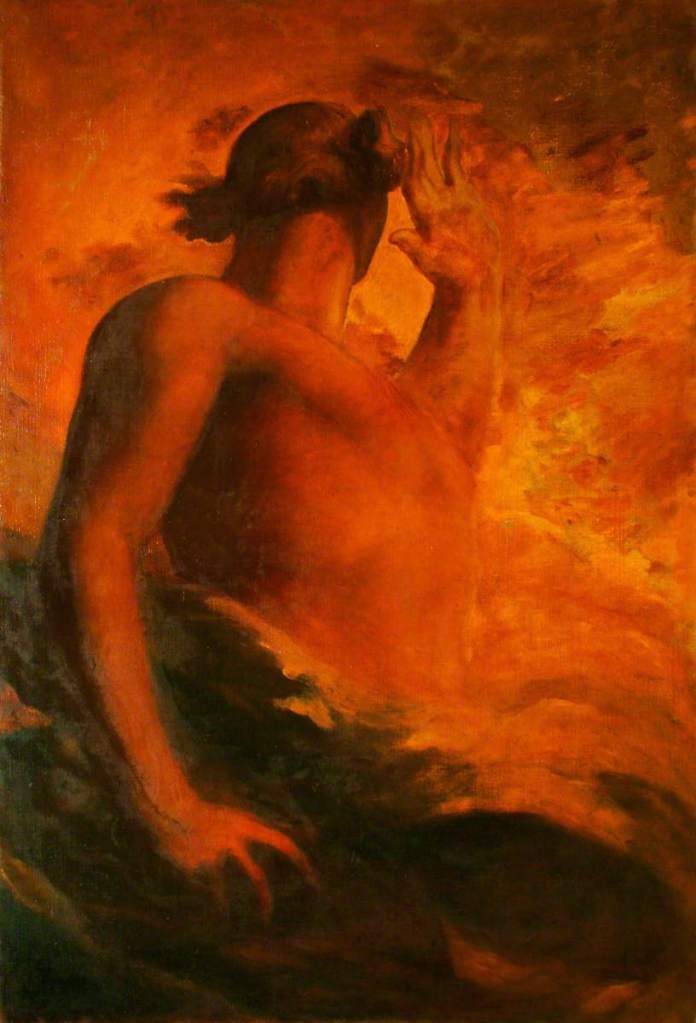
Watts, George Frederic; Satan; Watts Gallery; http://www.artuk.org/artworks/satan-13360 My first response was to study philosophy. I got a lot out of what I was exposed to, and I’m sure I’ll never be done reading philosophy. However, I always assumed that there would be some smoking gun argument that proved the nonexistence of God. To my disappointment, I did not find it. One argument for the nonexistence of God (among many) goes like this:
- If God exists, then God is omnipotent, omniscient, and morally perfect.
- If God is omnipotent, then God has the power to eliminate all evil.
- If God is omniscient, then God knows when evil exists.
- If God is morally perfect, then God has the desire to eliminate all evil.
- Evil exists.
- If evil exists and God exists, then either God doesn’t have the power to eliminate all evil, or doesn’t know when evil exists, or doesn’t have the desire to eliminate all evil.
- Therefore, God doesn’t exist.
For me, the problem with this argument starts at the top. To conclude that God doesn’t exist, you must define God in some way. Defining God in any way and in any language would require putting boundaries on the infinite. Because of this, arguing against the existence of what has been defined as “God” is pointless. The definition has split the whole of the infinite into “God” and “not God” and in the process has ceased talking about what people mean when they talk about God. Interestingly enough, this gets back to my original misgivings about God. On some level I was aware from a young age that the “God” I was praying to was just a thought or image in my head, which is no closer to being God than any definition that could be used to disprove God.
Because it appears impossible to talk about God, I have accepted that I’m never going to get an answer to the question of the existence or non-existence of God from the physical world, a book, or logical reasoning. Even if this sounds agnostic, I’m not agnostic. Taking a stance that there is no justifiable stance to take is just too ironic for my taste. So what am I talking about? No stance, no specific belief, and therefore, no conflict. Just a blank space where a belief used to be. As it turns out, my need to have a belief, an identity, an answer for anything, was always and will always be a problem that ceases to exist if I let it go.
-
Subscribe
Subscribed
Have a WordPress.com account? Log in now.

